The great books, explained.
Counsel is an iPhone app where you read the great books one idea a night, ask history’s great minds about a real decision, and practice the hard talk before it’s real.
So is your first rehearsal.
Very helpful and interesting idea.App Store review


A big idea, every night.
Painted and explained in about a minute, and free. Then six classics told idea by idea, from The Prince to the Tao Te Ching.
- Every idea starts with the real story: a court, a battle, a letter.
- Then it shows where the same thing turns up in your own week.
- Facts checked against the sources, quotes from public-domain translations.

 1513The PrinceThe quiet manual of power, from the man who wrote it.
 about 175 ADMeditationsAn emperor’s private notes to himself, on staying steady.
 about the 5th century BCThe Art of WarThe oldest book on strategy, for every kind of conflict.
 about 62 to 65 ADLetters from a StoicA retired statesman’s letters to a friend, on living well.
 about the 4th century BCTao Te ChingEighty-one short verses on doing less and forcing nothing.
 gathered 3rd century BCThe DhammapadaThe Buddha’s sayings in verse, on taming your own mind.
Read. Ask. Practice.
Read tonight’s idea.
A big idea from the great books, painted and told in about a minute, with where it shows up in your own week.
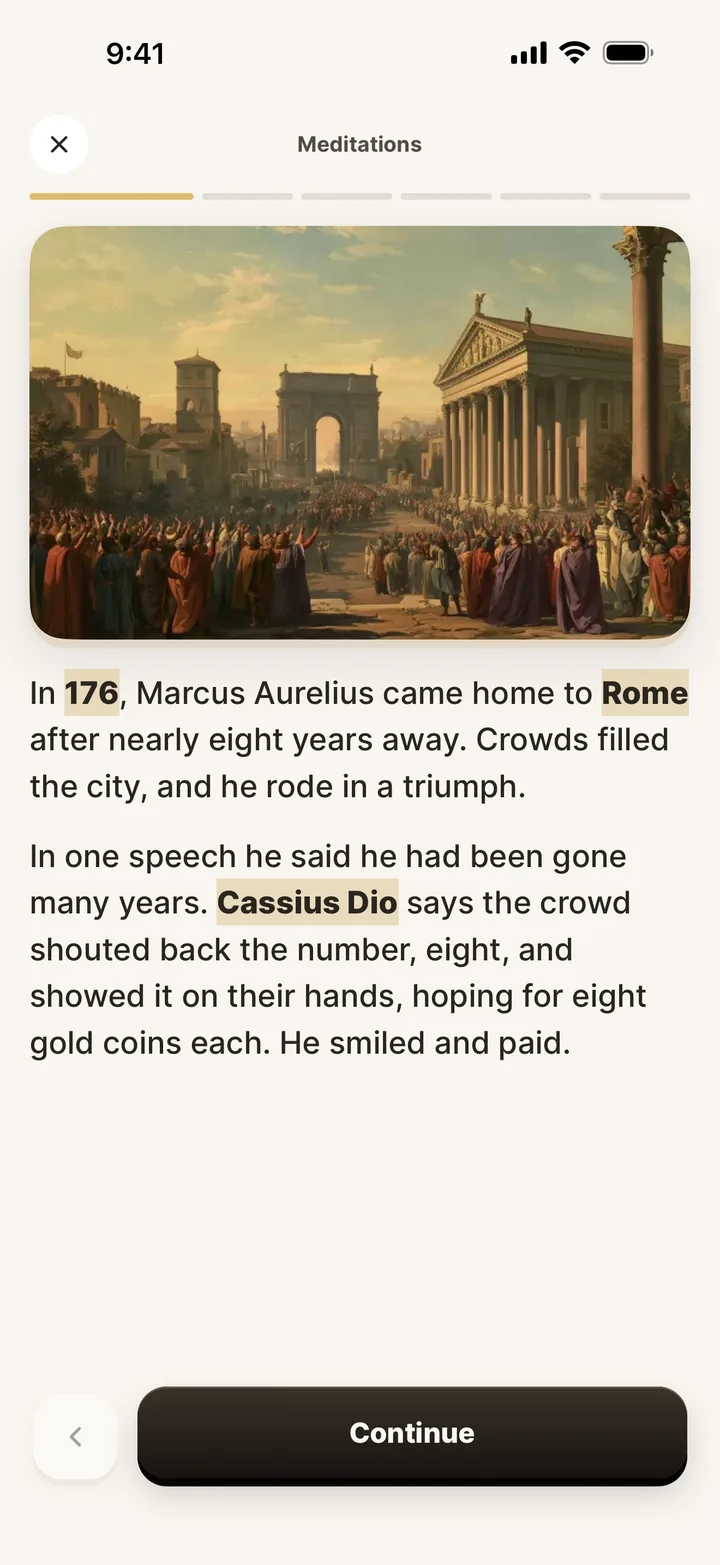
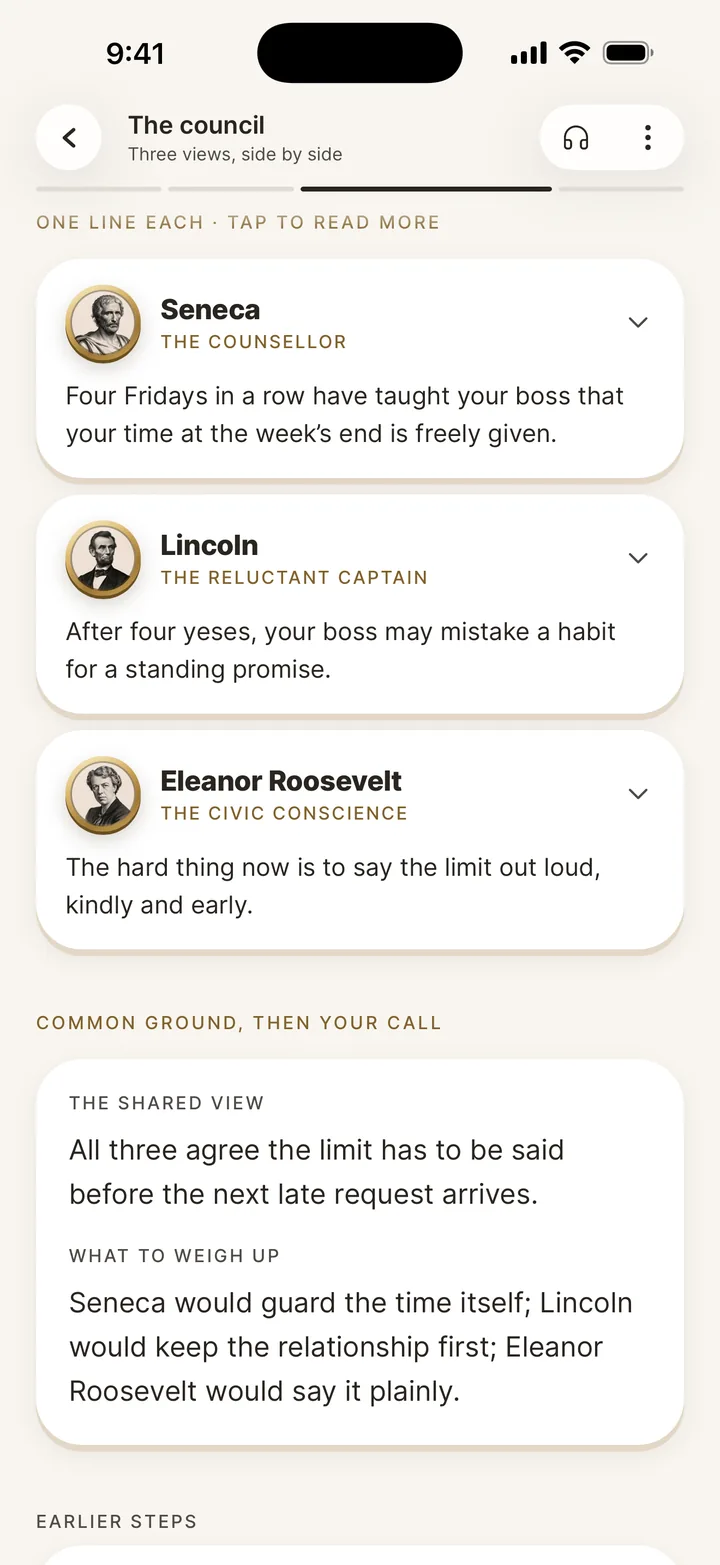
Ask your council about a real decision.
Write it the way you’d tell a friend. Three to five great minds each give their view, and you leave with one small next step.
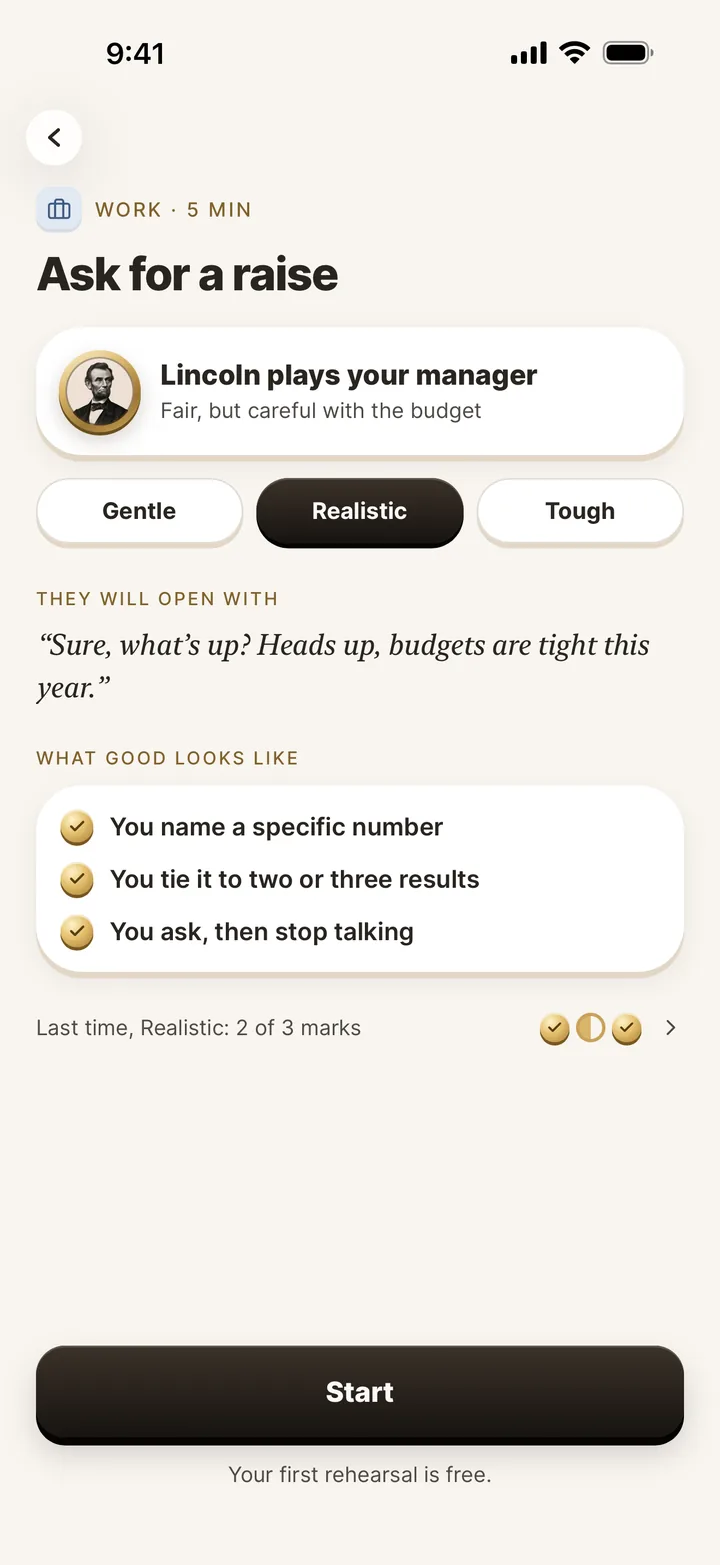
Practice the talk before it’s real.
A mentor plays the other person, at Gentle, Realistic or Tough. A coach steps in when a line slips.


Practice the talks you dread.
19 real situations at work and at home. Pick one to see who plays the other side, what they’ll say first, and what a good attempt looks like.
Ask for a raise

“Sure, what’s up? Heads up, budgets are tight this year.”
- You name a specific number
- You tie it to two or three results
- You ask, then stop talking

Your first rehearsal is free.
Ask for a raise
“Sure, what’s up? Heads up, budgets are tight this year.”
- You name a specific number
- You tie it to two or three results
- You ask, then stop talking
Your first rehearsal is free.
Negotiate my job offer

“We’re thrilled to offer $85,000. Can I tell the team you accept?”
- You thank them before you negotiate
- You counter with a precise number
- You don’t accept on the call

Your first rehearsal is free.
Tell my boss I’m overloaded
“Can you also grab the Henderson deck? Should be quick.”
- You say what is already on your plate
- You ask them to choose what drops
- You offer an option, not only a no

Your first rehearsal is free.
Tell my boss I’m quitting
“You wanted to talk? I’ve got ten minutes before my next call.”
- You say it in your first two sentences
- You give your last day
- You turn down a counteroffer kindly
Your first rehearsal is free.
Ask my manager to stop moving my deadlines
“Things change, that’s the job. Can you just make it work?”
- You give two real examples
- You say what it costs you
- You propose a simple rule, like a day’s notice

Your first rehearsal is free.
Ask a friend to pay me back

“Oh man, I totally forgot. Things are really tight right now.”
- You name the amount and a date
- You don’t apologize for asking
- You agree a plan, like two payments
Your first rehearsal is free.
Say no to a trip I can’t afford

“Everyone’s in! It’s only $1,400, you’ll regret it.”
- You say no in one or two sentences
- You don’t over-explain your money
- You suggest a cheaper way to join in
Your first rehearsal is free.
Ask my partner to share the housework
“I do plenty. Last week I did the dishes twice.”
- You name one or two specific tasks
- You ask to split them, without blame
- You stay away from “always” and “never”

Your first rehearsal is free.
Tell my partner they’re on their phone too much
“Hm? Sorry, I’m listening. Go on.”
- You describe one moment and how it felt
- You ask for one small habit, like phones away at dinner
- You stay warm, not accusing

Your first rehearsal is free.
Tell my partner I’m not happy

“Okay, you’re scaring me. What is it?”
- You say it plainly, with care
- You keep to one main thing
- You agree a next step together
Your first rehearsal is free.
Break up kindly

“You’ve been weird all week. What’s going on?”
- You say it early and clearly
- You leave no false hope
- You don’t argue about the reasons
Your first rehearsal is free.
Apologize after a big fight
“So, are you going to explain last night or not?”
- You own it, with no “if” or “but”
- You name how it hurt them
- You offer one way to make it right

Your first rehearsal is free.
Say no to my mother-in-law’s visit
“I already booked the whole week! You don’t mind, do you?”
- You say no warmly and clearly
- You offer the dates that do work
- You speak for both of you, not only yourself
Your first rehearsal is free.
Talk to my parents about their future
“I’m perfectly fine. Did your sister put you up to this?”
- You ask more than you tell
- You keep to one topic, like driving or money
- You agree a time to talk again
Your first rehearsal is free.
Ask my partner to back me up with their family
“She’s my mom. What do you want me to do, ban her?”
- You make one specific ask
- You don’t attack their family
- You agree what you’ll both say next time
Your first rehearsal is free.
Tell a friend I can’t lend money again
“It’s just till Friday, I promise. You’re the only one I can ask.”
- You say no clearly, without a made-up excuse
- You don’t reopen it when they push
- You offer help that isn’t money
Your first rehearsal is free.
End a friendship that’s run its course
“Hey stranger, are we still on for Saturday?”
- You are honest, and kind
- You don’t list everything they did
- You close it clearly
Your first rehearsal is free.
Tell my doctor what’s really going on
“Your labs look normal. Anything else today?”
- You name your main worry first
- You say how it affects your days
- You ask one specific question
Your first rehearsal is free.
Tell someone close I’m struggling
“What do you mean, struggling? You seem fine.”
- You say it plainly
- You say what help would look like
- You let it be enough for now
Your first rehearsal is free.
Sixteen great minds, on your question.
From Rome to China, from Stoics to strategists. Three to five sit on your council, and each reads your situation their own way.


Hear several views before you choose, not one voice telling you what to do.
Power and influence, courage, difficult conversations, long-term strategy, clear thinking. Two options and what each costs you.
Tap the headphones and hear any answer read aloud, with the text following along.
See how your decisions really went.
Most of what we dread never happens the way we picture it. Counsel keeps the record, so you can see it for yourself.
- Write what you think will happen when you save a step.
- Check in after. Your guess sits next to what happened.
- See your progress on each talk you practice, and the lines that worked.
Start without paying.
- Your first rehearsal of any talk
- The one-minute drills
- Tonight’s read, a new idea every night
- Your own next steps, with reminders and check-ins
- The journal and the Library
- One question and one mentor’s full answer
The whole council.
- The six classics and the collections
- Answers from your full council or an approach
- Every practice talk, as often as you like
- Listening to any answer
Weekly, monthly or yearly. Prices are shown in the app before you buy.
Very helpful and interesting idea.
It gives accurate, helpful and personalized recommendations that have been genuinely useful.
Application is very helpful and the advice was reasonable
Good to know.
What is Counsel?
Counsel is an iPhone app that puts history’s great minds on your side. Read their big ideas and the great books, explained in plain words. Describe a decision you are facing and hear how mentors such as Marcus Aurelius, Seneca and Cleopatra might weigh it. Practice the talk that comes with it, and leave with one next step you can save and try.
What is Read?
A big idea every night, painted and explained in about a minute, free. And six classics told idea by idea: The Prince, Meditations, The Art of War, Letters from a Stoic, the Tao Te Ching and The Dhammapada, twelve ideas each. Every idea starts with the real story, then shows where it lives in your own week. The classics, explained.
How does practicing a hard conversation work?
Pick a talk, like asking for a raise or telling your partner you are not happy, and how hard the other person pushes back: Gentle, Realistic or Tough. A mentor plays them. When a line works against you, a coach steps in with one tip and you can try it again. At the end you see three marks and your strongest line. Your first rehearsal is free. How practice works.
Which talks can I practice?
Nineteen, across work, money, love, family, friends and yourself: ask for a raise, negotiate a job offer, tell your boss you are overloaded, say no to a trip you cannot afford, break up kindly, talk to your parents about their future, tell your doctor what is really going on, and more. You can also practice a talk of your own. All the talks.
What are the one-minute drills?
Short drills for the moments that decide a talk: say your ask in one sentence, name the number, and handle the pushback. Three rounds each, checked on your iPhone. They are always free.
How do the mentors answer?
Each mentor is written from what they believed: how they argued and what they valued. AI writes the answers through Counsel's secure server. Quotes come from their own writing or are widely attributed to them. The mentors draw on figures from history; they are not the people themselves.
Which mentors are in the council?
Sixteen: Marcus Aurelius, Seneca, Sun Tzu, Machiavelli, Cleopatra, Lao Tzu, Confucius, Buddha, Sappho, Mary Wollstonecraft, Eleanor Roosevelt, Virginia Woolf, Frederick Douglass, Lincoln, Benjamin Franklin and Talleyrand. You choose three to five for each question. Meet them.
What is the Journal?
Your steps, guesses, practice and notes in one place. When you save a step you write what you think will happen, and when you check in, Counsel shows your guess next to what happened. Your record shows how often things went as well as you guessed, or better. Inside the journal.
Can I listen to the answers?
Yes. Tap the headphones on any answer and it is read aloud, with the text lighting up as the voice reads. The voice runs on your iPhone. It downloads once the first time, so Wi-Fi is best.
What are approaches?
If you want one clear line of thinking instead of a council, pick one of five approaches: Power & influence, Courage & uncertainty, Difficult conversations, Long-term strategy or Clear thinking. You usually get two options and what each one costs you, and the same one next step.
Is what I write private?
Counsel saves your consultations and journal on your iPhone. What you write is sent to Counsel's AI service only when you ask for an answer or practice a talk, and Counsel does not allow it to be used to train AI. You can export or delete your data at any time: tap your profile, then Privacy & data. The privacy policy has the details.
How much does Counsel cost?
Counsel is free to download. Tonight’s read (a new idea every night), your first rehearsal, the one-minute drills, your own next steps with check-ins, the journal and the Library are free, and a new install can ask one question and read one mentor’s full answer. The classics and collections, answers from your full council or an approach, more practice talks, the Sunday letter and listening need a weekly, monthly or yearly subscription. Prices are shown before you buy, and you can cancel at any time in the Settings app: tap your name, then Subscriptions.
Is Counsel a replacement for therapy?
No. Counsel is for thinking things through and practicing conversations. It is not therapy, and not medical, legal or financial advice. If you are in crisis, please talk to someone trained to help: 988 in the US, 116 123 in the UK, 13 11 14 in Australia, or findahelpline.com anywhere else. The Support page has the full list.
What do I need to use it?
An iPhone with iOS 17 or later. There is no Android or web version.
Start with tonight’s read.
Then ask history’s best minds about a real decision, and practice the talk before it’s real.
